What Time Do People Eat in Madrid (and Why)
You land in Madrid, get hungry around 7pm, walk into the first restaurant you see — and the kitchen doesn't open until 8:30. It's not bad luck. It's just that Madrid eats later than most of the world, and the reason isn't really about appetite or culture at all. It's about a clock decision made 85 years ago that Spain never bothered to undo.
The 1pm vermút ritual!
Before lunch, Madrid has its own ritual: vermút. Between 1 and 2pm, terraces around the city fill with people having a glass of vermút on tap alongside something salty — olives, a bit of cheese, a plate of bravas — as a warm-up before the main meal. It's the closest thing Madrid has to a late brunch, except here it works as a bridge to lunch, and it's also the perfect way to fill the gap if you've still got an hour to kill before the kitchens open.
What to do when you're hungry at the "wrong" hour
On the night of March 16, 1940, at eleven o'clock, Spain's clocks jumped forward an hour on Francisco Franco's order — a symbolic gesture of alignment with Nazi Germany, dressed up officially as "the convenience of Spain's timetable matching other European countries." Spain sits at the same longitude as the UK and Portugal and, by the sun, should share their time zone. It never switched back. Portugal, right next door and directly on the same meridian, still runs an hour behind Madrid.
That single wartime decision is the real reason Spain's schedule feels late: it isn't. By the sun, 2pm in Madrid is closer to 1pm, and a 10pm dinner is really a 9pm dinner in solar terms — roughly what most of Western Europe considers normal. Spaniards didn't decide to eat late; they inherited a clock that says "2pm" for what the sun still calls "1pm," and the whole day — work, lunch, siesta, dinner — got pushed along with it. It's a detail Spanish parliamentary commissions have periodically proposed fixing (there have been serious pushes to move Spain back to UK/Portugal time to help with sleep and productivity), and it hasn't happened yet. So for now, the clock says one thing and the sun says another, and everyone just built their day around the clock.
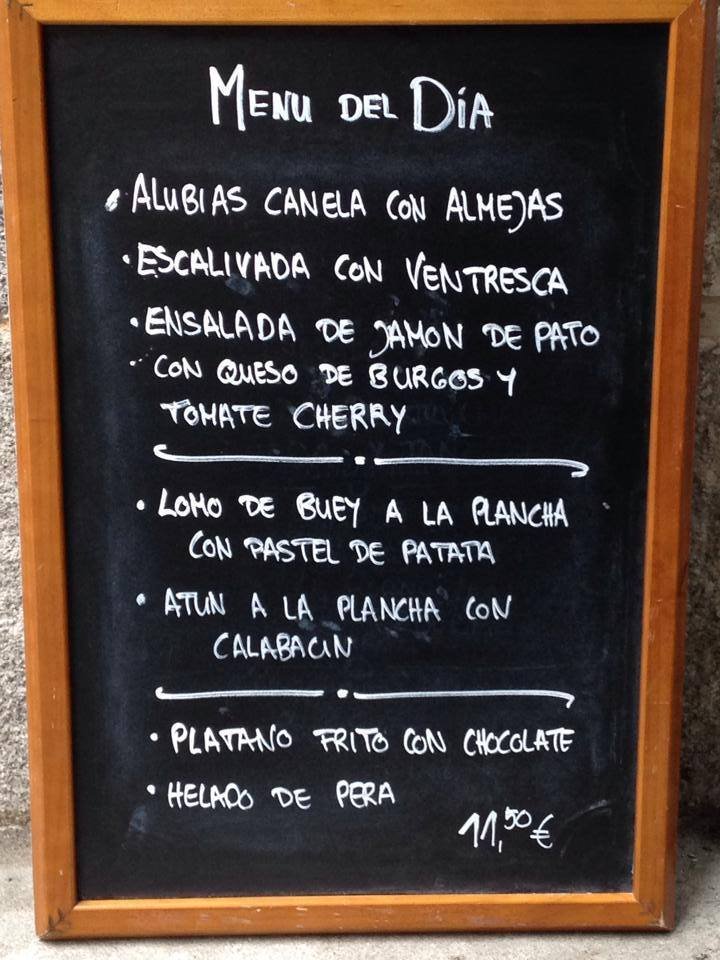
The menú del día: a narrow window worth knowing
The menú del día — a starter, a main, dessert or coffee, bread and a drink, all for one fixed price — is one of the best ways to eat well in Madrid without spending much. It dates back to a 1964 tourism-ministry order — Spain was in the middle of a tourism boom, going from under 3 million foreign visitors in 1959 to over 11 million by 1965 — that forced restaurants to offer a fixed-price meal for travelers. The regulation itself was scrapped in 2010, but the habit stuck: restaurants kept it because regulars kept coming back for it. It still runs on a strict schedule: typically 1pm to 4pm, Monday to Friday. Past that, it disappears from the menu. If you want to try it, sit down early rather than wander in at half past three.
How to adjust without giving anything up
You don't need to overhaul your entire trip to eat well here. A couple of small shifts do it: save your main meal for after 2pm, treat sobremesa — the unhurried chat that follows dessert, with no one rushing you for the bill — as part of the experience rather than a delay, and book dinner for 9pm if you want the room to actually feel alive. Showing up an hour or two early by your home-country clock usually means eating in an empty room; showing up on Madrid time means eating surrounded by the noise and energy that make a meal out here worth having.
Why a food tour takes care of this for you
All of this — which places keep the kitchen running all afternoon, which ones are actually full of locals rather than passersby, what time a spot is worth sitting down at — is exactly the kind of detail a local knows without thinking, and a visitor usually only picks up after a full trip. On a Flavours of Madrid food tour, the route is built around the city's actual clock, not against it: stops timed for when each place is at its best, no closed kitchens, no tourist-trap tables, no waiting around for a schedule nobody told you about.
How to tell an authentic all-day spot from a tourist one
Plenty of places advertise a kitchen open non-stop from noon to midnight — that alone isn't a sign of quality, it's a sign the place is built for people who don't keep Madrid's schedule. Two quick checks help separate the ones worth it from the ones that aren't:
Look at how full it is at the actual local hour. A bar with an all-day kitchen that's still half-empty at 2pm or 9:30pm, when Madrid is properly sitting down to eat, is usually running on tourist traffic rather than a regular local crowd. The good ones fill up right when they're supposed to.
Listen before you sit down. If most of what you hear around you is Spanish, that's a solid sign you've found somewhere locals actually choose, not a spot built for whoever walks past.
Neither trick is foolproof alone, but together they're a fast way to tell a place that happens to serve all day from one that's just there to catch foot traffic.