Chamberi: All You Need to Know About Madrid's Most Castizo Neighbourhood
Most visitors to Madrid never make it past Sol, Gran Vía and La Latina. That's a shame, because ask a Madrileño where they'd take you to eat, drink and actually feel the city, and a good number will say Chamberí — a district north of the centre that local press has taken to calling el barrio más castizo de Madrid, the neighbourhood that still carries the city's original character. It isn't marketed as a tourist destination. That's rather the point.
A neighbourhood built by decree
Chamberí wasn't always here in any organised sense. Through the Middle Ages the land belonged to the Order of the Temple, and by the mid-19th century it was still a modest cluster of about 700 residents, a few tile factories and a chocolate mill on the northern edge of the city. Everything changed on 19 July 1860, when a royal decree approved the Ensanche — Madrid's great 19th-century expansion plan, drawn up by the engineer Carlos María de Castro. The plan tripled Madrid's built-up area over the following decades and created what are now some of the city's most recognisable districts, Chamberí among them.
The new Chamberí attracted Madrid's rising bourgeoisie and, in time, some of its best-known cultural names — the novelist Pérez Galdós, the painter Joaquín Sorolla, the poet Antonio Machado and the writer Pío Baroja all lived here. (As for the name itself, local tradition holds it comes from Napoleonic troops — a regiment from Chambéry, in Savoy — who camped on what's now Plaza de Chamberí during the occupation of Madrid. It's a nice story, and a widely repeated one, though it's worth treating as neighbourhood folklore rather than settled fact.)
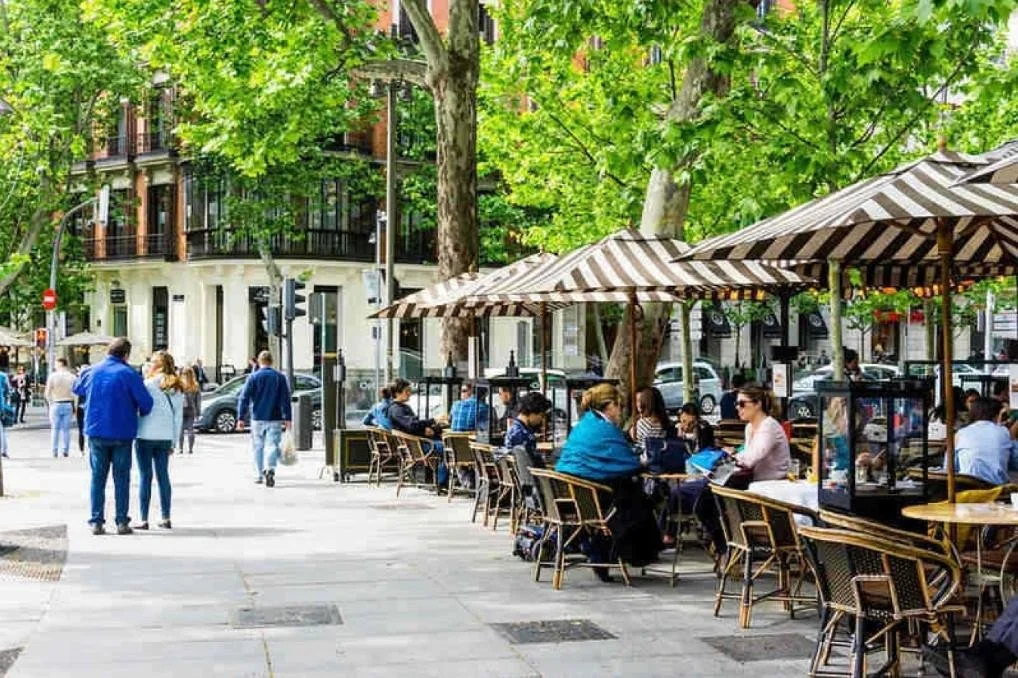
Calle Ponzano: the city's busiest tapeo strip
A few streets north, Calle Ponzano is Chamberí's busiest stretch of tapeo: barely a kilometre long, and packed with close to a hundred bars and restaurants — densely enough that Madrileños coined a verb for working your way down it, ponzaning. It's loud, it's crowded on a Thursday night, and it's about as far from a curated "tourist tapas street" as Madrid gets.
Our recommendations : places on Ponzano open and close all the time. Right now, we'd point you to:
- the seafood counter at Marisquería Fide (with a second address just around the corner),
- Bokaxanca Bar,
- a cheescake at Luna at Wanda,
- or a glass of wine at the newly opened Nolita.
Plaza de Olavide: the square where a market disappeared and a meeting point took its place
No guide to Chamberí can skip Olavide. Ask a local where everyone actually ends up, and this octagonal square in the Trafalgar neighbourhood is almost always the answer — it's the closest thing the district has to a living room. It got there in a roundabout way. From 1934, the square held its own covered market, a rationalist iron-and-concrete octagon designed by the architect Francisco Javier Ferrero Llusiá and considered strikingly modern for its time. It didn't survive: on 2 November 1974, the city brought it down by controlled blasting, giving residents less than 48 hours' notice and instructions to keep their windows shut through the morning. The demolition itself misfired in places, damaging nearby buildings, and split opinion sharply — Madrid's official college of architects (COAM) had formally opposed tearing it down.
What stands there now is what replaced it: gardens, a fountain, an underground car park, and, eventually, the terraces everyone actually goes to. The novelist Francisco "Paco" Umbral once called the square the heart of Chamberí; another writer, Reig, called it the liver, a nod to the old market. Long-time residents describe it more simply, as the neighbourhood's real meeting point — it's where Chamberí's first 15-M gatherings met in 2011, and where locals still land most evenings. It's also, officially, a "zona saturada de terrazas": city measurements have found outdoor tables occupying more than 90% of the pavement on some stretches, which is either exactly why it's worth a visit or exactly what the neighbours are tired of, depending who you ask.
Why the Best Food Tour in Madrid Won't Come From a Company That Also Runs Tours in Rome, Paris, and Lisbon
Mercado de Vallehermoso
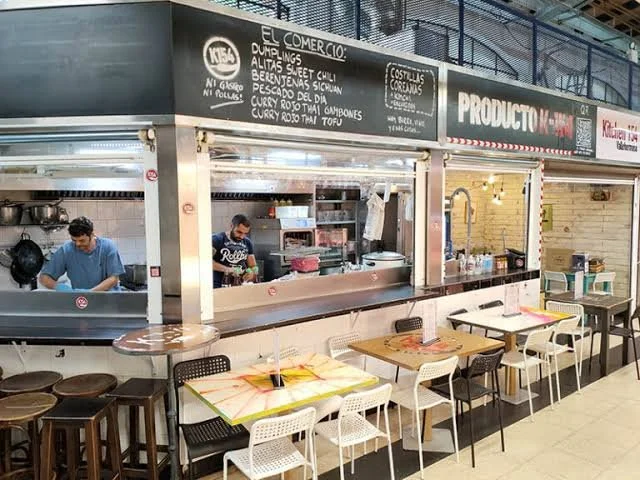
Behind its crimson 1933 façade, Vallehermoso doesn't read like a market that needs preserving — it reads like one of the best-curated food halls in Madrid, and increasingly one of the most written-about. Skip the produce stalls (that's where the neighbourhood does its Tuesday-morning shop, not where a visitor needs to be) and head straight for the counters that have Madrid's food press paying attention.
Krudo runs its raw bar around a single seven-seat metal counter, so you watch the knife work happen in front of you: fish cured with Mexican chintextle, black garlic dressings, shallot and lime, threading Peruvian, Venezuelan and Thai technique through Spanish product, alongside a small natural-leaning wine list built by Paula Prokopiak. Batch, a few steps over, splits itself between shop and gastro-bar — ferments, natural wines, house kombucha, and seasonal plates with real technique behind them, closer to a chef's counter than a market stand. Guía Repsol has already given it a Solete.
Then there's Tripea, a Peruvian stall that Madrid's own chefs' association (ACYRE) has named the best market stall in the city — order the hot mussel ceviche, wok-fired, and the reason why becomes obvious fast. Biáng Biáng does hand-pulled Chinese noodle bowls, Craft 19 covers pastrami, burgers and pulled pork alongside a serious craft beer list, and Washoku handles sushi, including a crispy fried-salmon maki worth the short wait.
The ghost station under the neighbourhood
Chamberí keeps one more thing most visitors walk straight over: a Metro station that hasn't run a train since 1966. Chamberí station opened on 17 October 1919, designed by the architect Antonio Palacios as one of the eight original stops on Madrid's first Metro line. When the network switched to longer trains in the 1960s, Chamberí's platforms couldn't be extended to fit them, and on 21 May 1966 the station was sealed rather than rebuilt — trains kept running through without stopping, past dark platforms still hung with 1919-era enamel advertisements. It reopened in 2008 as Andén 0, a small free museum, with those original tiled ads and period fittings still in place. It's a five-minute stop, and one of the more quietly remarkable things in the city.
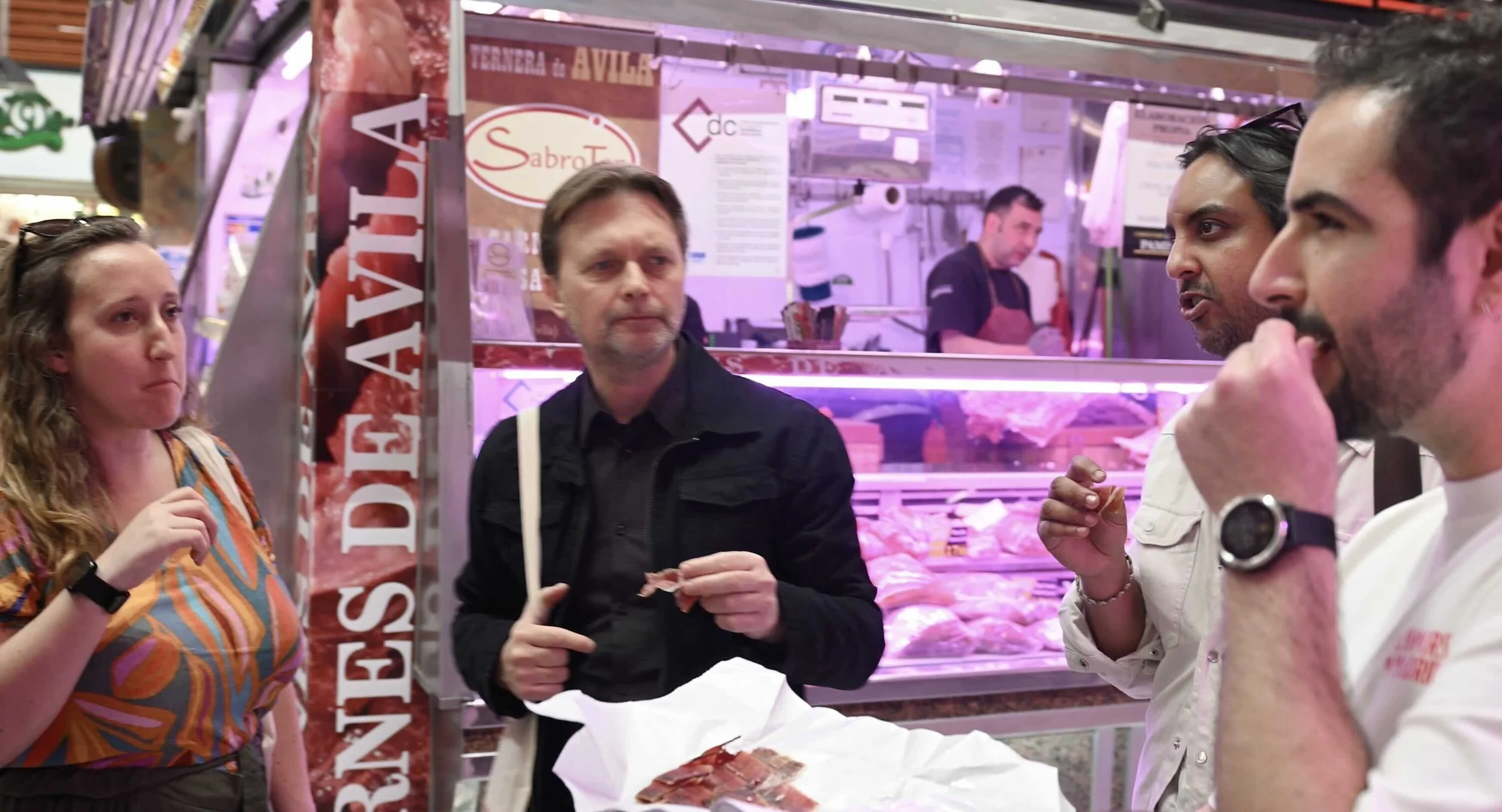
Where our tour fits into all of this
Our flagship experience, Authentic Madrid, runs through Chamberí rather than the centre, for the same reason this piece exists: it's a neighbourhood you can actually get to know, not just pass through. It's where we stop at the market, where our jamón maestro cortador works, and where a bar that's been pouring vermút since 1949 is still full of the same kind of regulars Alejandro used to serve two streets over. None of that comes from a script — it comes from being the people for whom this is also just the neighbourhood, not a stop on a route.